COLUMBUS, Ohio (WCMH) — Growing up in Pennsylvania, Ben Gelber remembered thunderstorms that would roll over the Pocono Mountains, bringing crashes of thunder and bursts of rain.
It seemed like they came without warning, and they frightened young Ben, especially the lightning. Then he had an idea; it came like a flash. If he knew why there was lightning, it wouldn’t seem that bad.
“I was extremely frightened of thunderstorms,” Gelber said. “The boom, lightning and thunder. That led me to learn more about severe weather, as a way to mitigate the phobia. … What I learned is studying these phenomena from a science standpoint can sometimes tamp down the anxiety.”
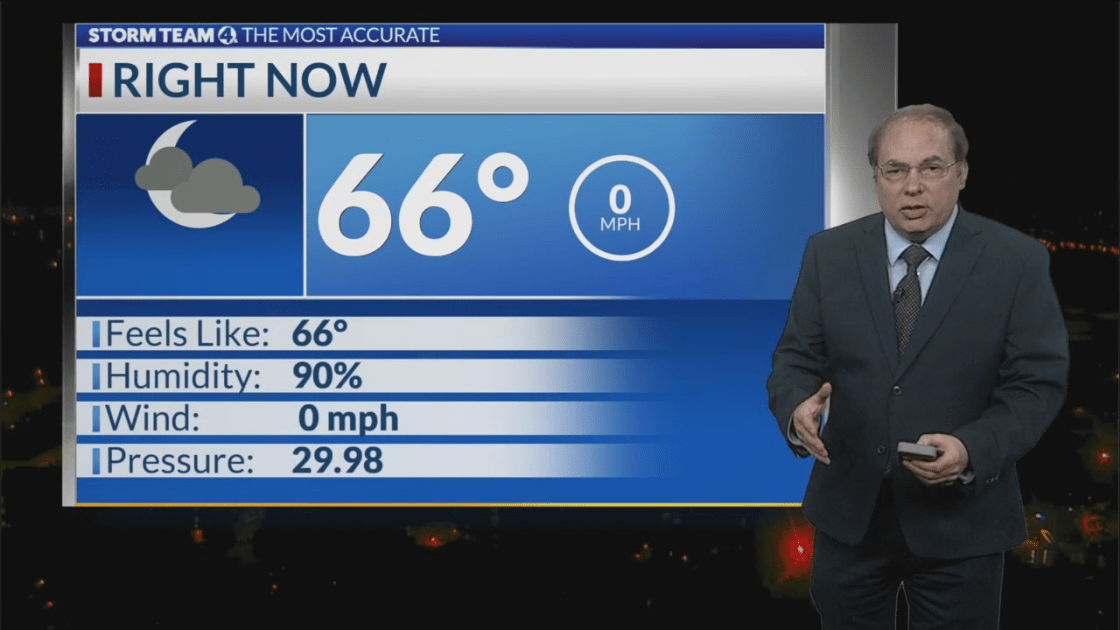
Today, Gelber knows how lightning works, how air can act as an insulator between opposing charges within the ground and inside storm clouds, leading to bright bursts of electricity. He can even tell you when it’s coming. He knows all about lightning, thunderstorms, tornadoes, derechos, bomb cyclones, snow rollers and all kinds of meteorological phenomena. He’s written the book on Pocono Mountain weather patterns. You can buy it on Amazon, alongside his other book on Pennsylvania weather.
And he knows even more about the weather in central Ohio.
In a matter of weeks, Gelber will mark 44 years of forecasting for NBC4 and WCMH — which is celebrating its 75th anniversary in 2024 — a run that makes him the longest-tenured on-air personality currently at the station. But that’s just one of the many things that makes him the mighty Ben Gelber.
With his reserved demeanor, he may seem like an odd choice for a television medium that favors the outgoing, but watching him a little bit reveals his endearing qualities: his extensive knowledge, his reliability and his earnestness. And he’s not only a meteorologist. He’s a journalist and an author. His wit is razor-sharp. He teaches, as did both his parents, lecturing at Ohio State University. He’s a musician. He’s arranged music, but perhaps most infamously, in 1995 he was the subject of a song.
“I was mortified,” he said. “It’s hard to hear a parody directed at you. And then you wonder, what is everyone else thinking? And where can I hide?”
Watch: ‘Here Come the Ben Gelber’
“Here Come the Ben Gelber” may be the best remembered of any of the decades of parody songs to come from WNCI’s Morning Zoo. (That’s not hyperbole. There was a thread on the Columbus subreddit just last month, with commenters swapping lyrics.) But the reaction was hardly what Gelber feared. Instead of letting him hide, WCMH decided to promote the song by making a music video, something that has probably allowed it to linger all these decades in the Columbus consciousness.
“Channel 4, you could have easily went, well, we’re not going to play that game. No, you embraced it,” WNCI’s Dave Kaelin said. “You did a full-on video. You took it to a new level.”
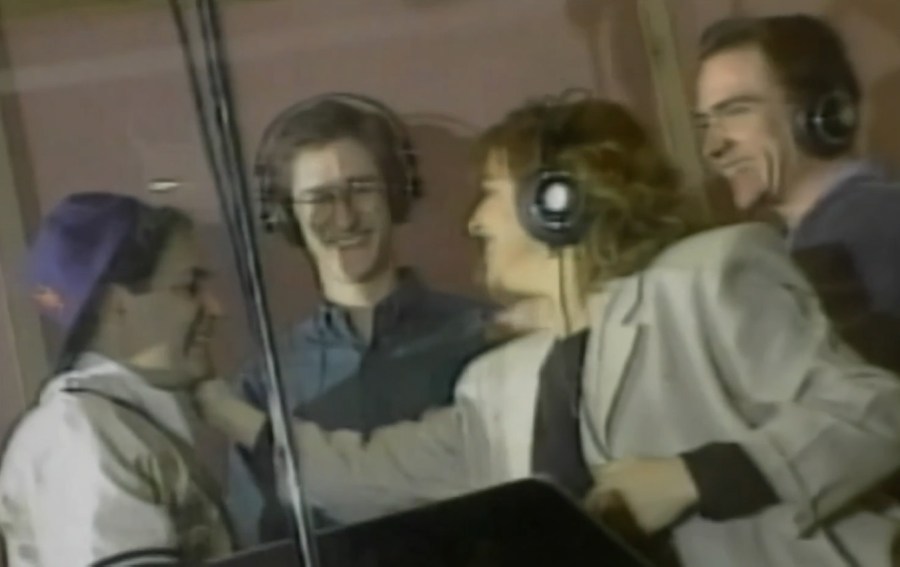
Kaelin was part of the Morning Zoo lineup then with Matt Harris and Kathy Hart, and he remains there today on Dave and Jimmy. The parody was taken from “Here Comes the Hotstepper,” a time capsule of a one-hit wonder by Ini Kamoze that interrupted a six-week run at No. 1 on the Billboard Hot 100 for Boys II Men’s “On Bended Knee.” Kamoze was a dancehall artist and professed “lyrical gangster” from Jamaica who mixed references to sports star Bo Jackson and television show In Living Color with “hotstepper,” a supposed slang term for a person eluding the police, over top of chants of “murderer.”
The parody’s lyrics referenced Gelber’s haircut and height, but they never came across as mean-spirited, also mentioning his book on the Poconos, his brains and his passion for giving the weather, as the chants of “murderer” were replaced with calls for “camera” and the chorus concluded with, “Gotta love him for that.” The third verse wrapped with the phrase that’s been associated with him ever since, “the mighty Ben Gelber.”
WCMH’s video was 2 1/2 minutes which proved Gelber was anything but stiff and stoic. Many of the video’s ideas came from him: exhaling to animate cloud cover on a radar map, climbing a ladder to point out a jetstream and pushing a shot of news anchors out of the way so he could start weather sooner. At one point, a record scratch interrupted the song as Gelber did a shockingly good impersonation of Dana Carvey’s take on President George Bush from “Saturday Night Live.”
Rarely will six months go by when the song isn’t mentioned or circulated around the NBC4 newsroom. The most recent time came in May, when Columbus city officials visited to recognize Gelber, Chief Meteorologist Dave Mazza and all of Storm Team 4 after WeatheRate ranked it central Ohio’s Most Accurate Forecast for the 10th straight year.
“On my first day here, I got to meet the mighty Ben Gelber,” anchor Kerry Charles said. “Growing up in Columbus, it was a big thing when that video came out.”

Columbus City Council presented a resolution that day to Storm Team 4, although it was hardly the first time that Gelber, who’s been a source for stories in The New York Times, had been recognized.
Gelber has done much more over the years than the video to show his lighter side. A longtime fan of the New York Mets and Penn State Nittany Lions, he ventured into sports for on-air science segments, learning curveball mechanics at Huntington Park and attempting a field goal at Ohio Stadium. (It was good.)
Jerod Smalley, now an anchor but for years NBC4’s sports director and host of “Football Friday Nite,” recruited Gelber for skits on the show. One showed him giving Smalley a pep talk in the form of a forecast. Another featured the ensemble “Ben Gelber and Friday Night Live Music” doing a version of the show’s theme that Gelber arranged.
“Friday Night Live” remains active with 15-20 musicians. Gelber started it during a difficult period when his father, an Air Force veteran who taught Ben how to distinguish types of clouds, had been diagnosed with dementia, and his mother had been diagnosed with cancer.
“My goal in 2010 was to create a community outreach music program that served multiple needs, including providing programs for seniors,” he said. “My father had begun a period of early dementia, and we know how important music therapy is.”
The ensemble has performed at Jewish community centers, senior living facilities, even Ohio State’s James Cancer Hospital. It recorded an album called “Boychikz II Mensch” – undoubtedly another charley horse for “On Bended Knee” – and Gelber has found the ensemble provides him connections to his loves of music, family and faith.
“As I grow older, there’s even more nostalgia for me and a desire to honor our past heritage,” he told Columbus Jewish News in 2023. “I’ve always enjoyed playing the music, and have learned so many more melodies taught to me by our musicians. It also happens to be a lot of fun.”
What’s fun for Gelber may seem like work for others, but then again, people often watch him work so they can know when they can have fun outside. He appears during NBC4’s weekend evening newscasts and on some weekdays. He’s used to the odd hours, with his time at the station dating to 1980.
When he was hired as WCMH’s second meteorologist, he was told he’d hand off weather reports for anchors to read until his training period was over. Then on Saturday, July 12, less than two weeks later, a severe thunderstorm warning was issued moments before the 6 p.m. news.
“I about had a panic attack,” he said. “I was supposed to be handing the copies to the anchors, but the producer looked at me and said, ‘You’re doing the weather now.’”
Becoming comfortable on camera has been one of many ways that Gelber said he has pushed and challenged himself through his life. And he certainly has, reporting live next to floodwaters, visiting areas damaged by tornadoes and, equally intimidating but in a different way, speaking in front of schoolchildren. When he visits, teachers often play “Here Come the Ben Gelber.”

Looking back at four decades of forecasting, he’s impressed by the evolution of weather technology, both in the tools he has available and how he can present information. He used to receive updated weather maps over facsimile machines that printed them out in strips he had to assemble to see the whole picture. On air, he initially stood in front of physical maps, with magic marker indicating frontal boundaries and pressure systems. Vinyl numbers were adhered to plexiglass to indicate high and low temperatures. One time, Gelber’s hand struck the map a little too hard and some of the numbers dropped, leading him to ad-lib how temperatures were “falling in the Plains.”
WCMH was the first television station in Columbus to incorporate live weather radar into its forecasts, and Gelber was there for it, witnessing a feed that brought in a new image maybe five times an hour. Live radar has become so sophisticated that it can now detect where tornadoes may be forming. And newer computer modeling can predict weather conditions down to the minute.
“We’ve always focused on severe weather safety,” he said, “but we couldn’t show internally what storms were doing. We couldn’t see that a thunderstorm was rotating and capable of producing a tornado until we had Doppler radar. And now we have all the various tools that allow us to distinguish between a heavy rainstorm, one that’s producing strong winds, one that may have hail, or one that is rotating.”
It’s a long way from the Pocono Mountains of his youth, where Gelber said his earliest memory was walking around outside after a “deep historic snowfall.”
“For some reason, I just loved snowstorms and developed a memory for dates and accumulations and a deep-seated interest in what causes these snows,” he said.
And it’s something he’s shared with central Ohio now for nearly 44 years.
Gotta love him for that.