In its near 100-year history, the FIFA World Cup has thrown up results that sparked global shock, nationwide trauma and the culmination of football generations that promised so much.
The beauty of sport lies within its unpredictability, and soccer’s grandest stage so often functions as a medium for the unlikeliest of upsets to play out.
The next David vs. Goliath parable is seemingly only ever the next tournament away, but it’s not merely giant killings that make up Sports Illustrated’s 10 biggest shock results at the World Cup. There’s been stunning behemoth-on-behemoth slayings, too, and unexpected outcomes on the biggest occasion of them all.
Ranking the Most Shocking World Cup Results of All Time
10. East Germany 1–0 West Germany (1974)
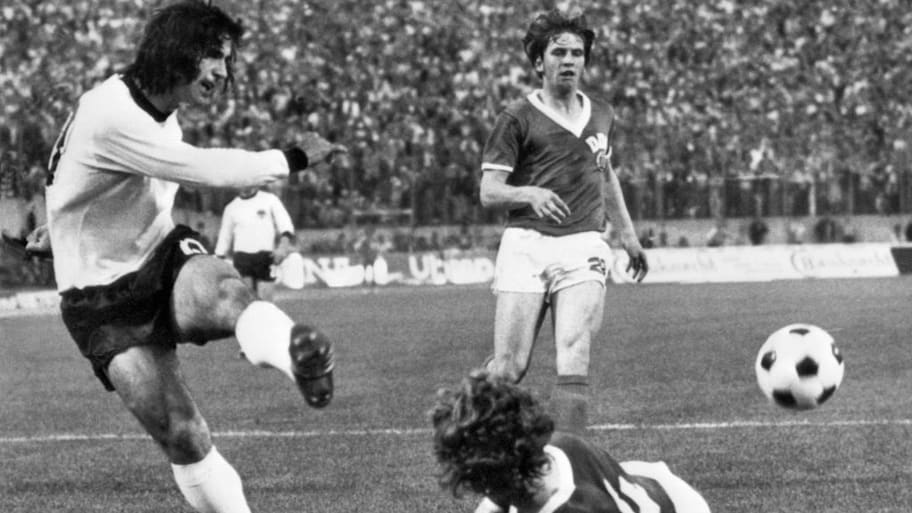
Franz Beckenbauer would later predict that Germany’s reunification of East and West would render the nation “unbeatable for years,” but it was still an almighty upset when East toppled West during the 1974 World Cup, hosted on German soil.
It was the only ever meeting between the ideological rivals, with Germany split into two at the end of the Second World War.
West Germany was the supreme force, and they headed into their home tournament as the European champions, with the bohemian playmaker Günter Netzer inspiring their success at Euro ’72. Their team had evolved by the time this tournament rolled around, though, with Beckenbauer and Gerd Müller the lead protagonists.
Both sides were assured of qualification entering their unprecedented duel, but the West were still expected to cruise. Instead, it was the unfancied East who prevailed courtesy of a Jürgen Sparwasser finish 12 minutes from time, proving themselves during the first group stage to be anything but slouches.
The result arguably worked in West Germany’s favour, though, as they enjoyed an easier set of fixtures in the next phase before going on to beat a generation-defining Netherlands team in the final.
9. Argentina 1–2 Saudi Arabia (2022)
If there’s a time to play Argentina at the World Cup, it’s probably on Matchday 1 of the group stage.
Expectations were high for Lionel Scaloni’s side entering the winter tournament in Qatar. They were 36 games unbeaten and poised to kick off their campaign in the Middle East with a serene win. Everything was going to plan against the 51st-ranked side in the world, with Lionel Messi coolly dispatching a penalty in the opening exchanges.
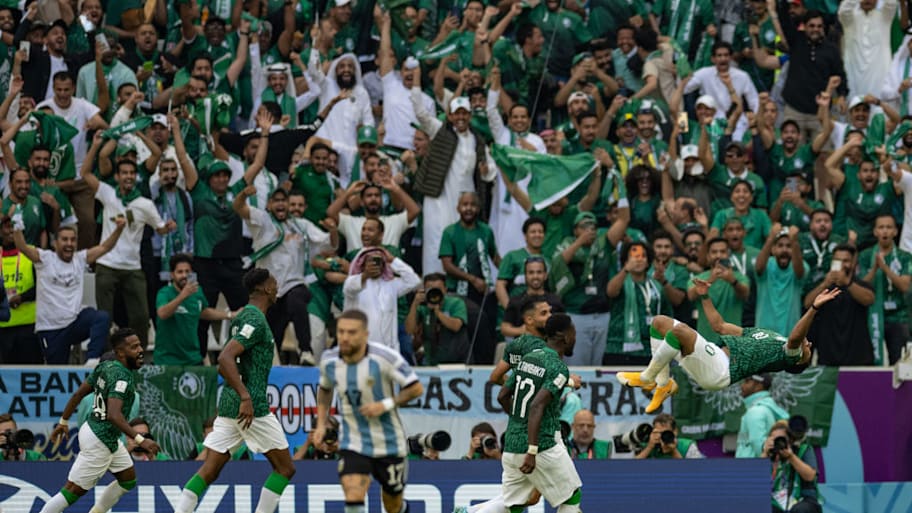
However, within 10 minutes at the start of the second half, Argentina’s world was turned upside down. Saleh Al Shehri drew the Green Falcons level, and their stunning turnaround was completed by a wonderful Salem Al Dawsari strike that Emiliano Martínez could only palm into his top left-hand corner.
Argentina had plenty of time to respond, but they were caught cold against the brave and courageous Saudis, who barely gave them a sniff and produced one of the all-time World Cup upsets rather comfortably.
8. Spain 1–5 Netherlands (2014)
France in 2022 broke the mould. Up until that point, defending champions hadn’t merely struggled in 21st century World Cups, but capitulated dramatically.
Spain’s success in 2010 reflected the dominance of their pass-heavy style, but there had been warning signs at club level between the two tournaments that a potential changing of the guard regarding philosophical hegemony was on the horizon.
German ’gegenpressing’ was suddenly the rage, but it wasn’t Joachim Löw’s eventual world champions who’d crush Spanish spirit in Brazil. That was the Netherlands’ doing.
Spain had lost just two of their previous 37 games ahead of the 2014 World Cup opener, and a first-half Xabi Alonso penalty seemingly set them on their way for another triumph. However, the beaten finalists in South Africa rallied with a vengeance.
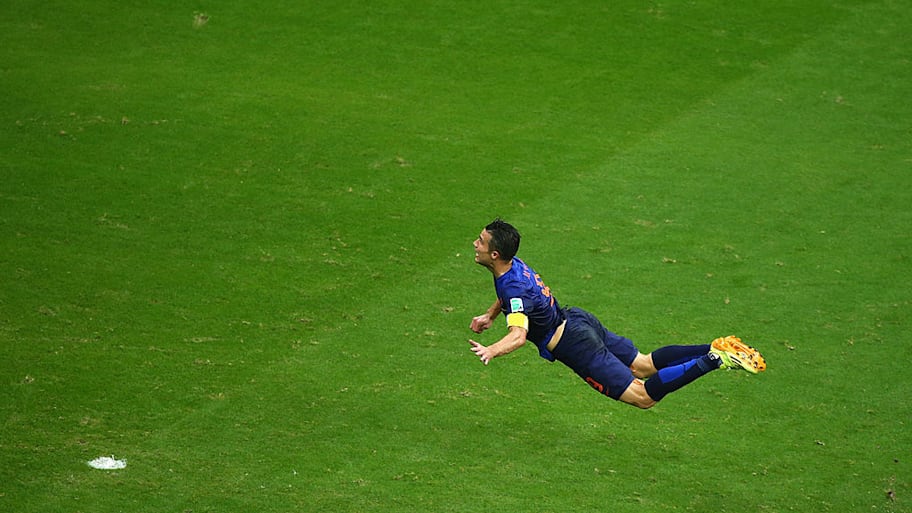
Inspired by Robin van Persie’s iconic flying header, the Dutch ran riot in the second half. Spain couldn’t contain an Arjen Robben who operated centrally, and the former Bayern Munich superstar completed the rout with his second goal against a defence that had no answer to his pace on the counter-attack.
7. Italy 0–1 North Korea (1966)
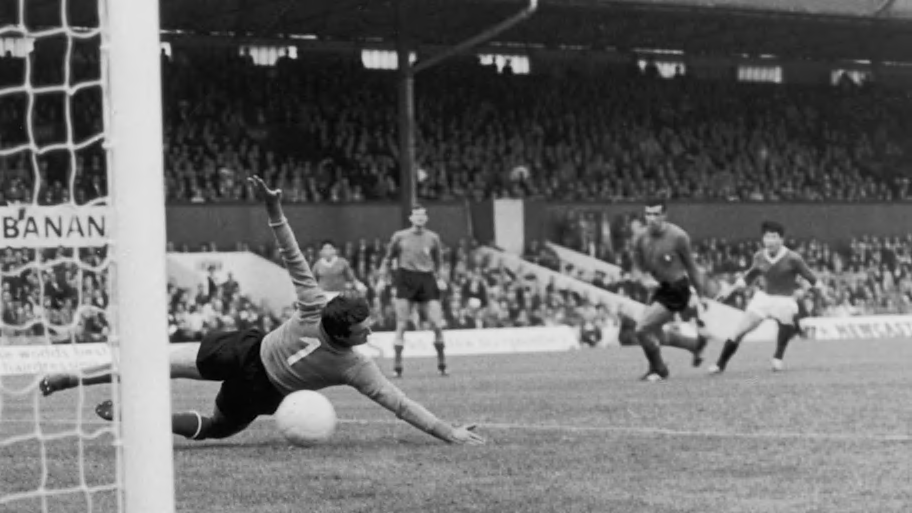
Benito Mussolini’s blackshirts had triumphed in 1938, but Italy had a wretched World Cup record between their second success and 1970, where they finished runners-up to an all-time great Brazil team.
The Azzurri failed to get out of their group in 1950, 1954 and 1962, and didn’t even qualify for the 1958 tournament in Sweden.
However, there was a sense that in 1966, with the Italians merely having to travel to the British Isles, Edmondo Fabbri’s squad could replicate the inglorious triumphs of the 30s. Italian sides had won three of the previous four European Cups heading into the tournament, with the great Giacinto Facchetti and Sandro Mazzola among those who travelled to England.
They arrived at Middlesbrough’s Ayresome Park on the final group stage matchday knowing that a point against tournament debutants North Korea would be enough to send them through to the quarterfinals.
A dynamic Korean side had garnered plenty of plaudits on English shores, and the Italians were set back by Giacomo Bulgarelli’s withdrawal through injury in the first half. With the concept of substitutions not yet established, they played the rest of the game with 10 players, and North Korea quickly took advantage.
A clever finish on the turn from Pak Doo-ik just before half time proved to be the game’s only goal, as goalkeeper Ri Chan-myong, who “guarded the goal with my life,” preserved North Korea’s unlikely lead and set up a staggering quarterfinal with Portugal.
6. West Germany 3–2 Hungary (1954)
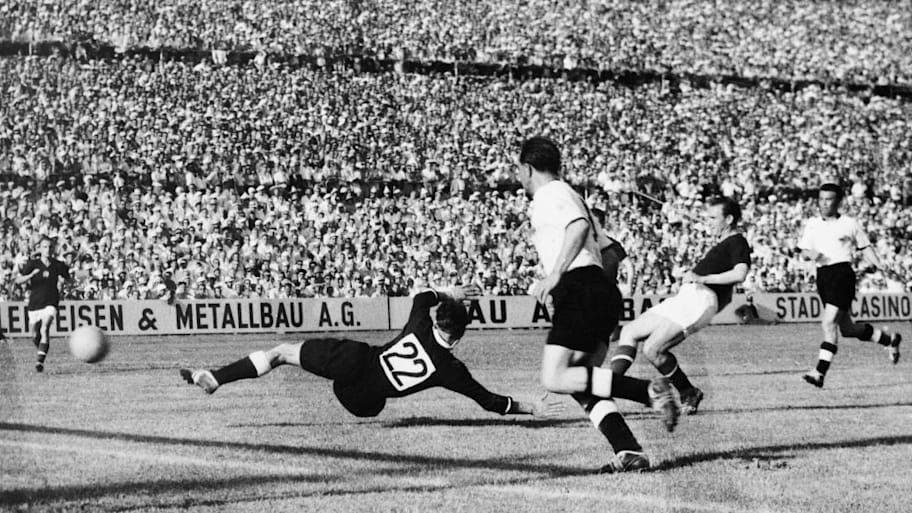
This would hardly be regarded as a shock in the present day (with a divided Germany suggesting something has gone incredibly wrong geopolitically), but West Germany’s victory over Hungary in the 1954 final was a seismic upset.
The ’Mighty Magyars’ were the neutral’s favourite. They’d dazzled an English audience at Wembley the year before, and the tournament in Switzerland was poised to be their crowning glory.
Their campaign started with 9–0 and 8–3 victories, the latter against the West Germans, no less, in the group stage. Although Brazil and Uruguay challenged them somewhat in the quarterfinals and semifinals respectively, they were massive favourites for their rematch with West Germany in the showpiece event.
English defender Syd Owen described his experience of facing this masterful Hungarian team as “like playing people from outer space,” and the West Germans felt their wrath again in the opening stages of the final. Hungary took a 2–0 lead inside eight minutes. Another rout was on the cards. Two more goals arrived within the next 10 minutes, but instead of 4–0, it was suddenly 2–2. Out of nowhere, the underdogs were level. The ’Miracle of Bern’ had begun.
The contest was more subdued after its early blitz, with a boggy pitch inhibiting Hungary’s telepathic fluidity. Eventually, the collective resilience of a German side keen to reassert itself on the global stage in the aftermath of World War Two struck the decisive blow six minutes from time. “Goal for Germany! Germany lead 3–2! Call me mad, call me crazy!” Herbert Zimmerman famously belted out on commentary when Helmut Rahn scored his second goal of the game.
Over a period of almost six years, Hungary played 51 matches and lost just once. It had to be the World Cup final.
5. Argentina 0–1 Cameroon (1990)
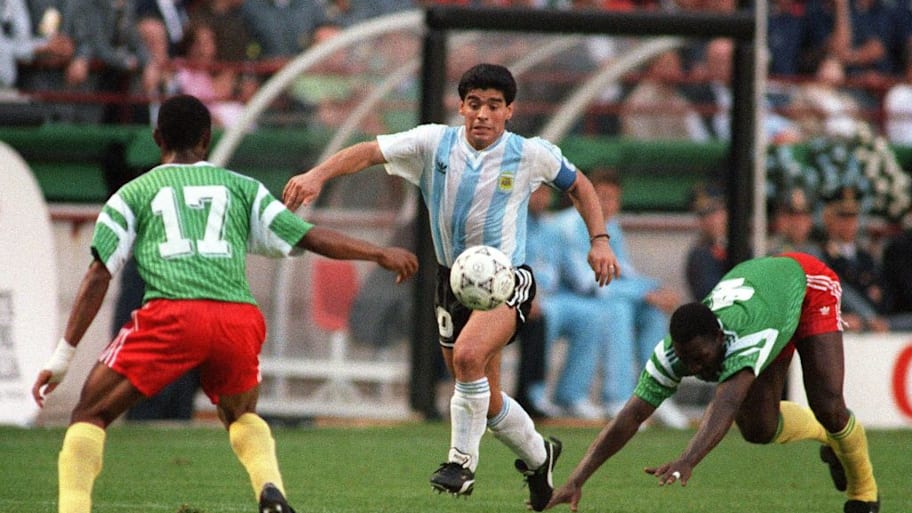
Once upon a time, it was the defending champions—not the hosts—who competed in the World Cup’s opening game, and Argentina faced a unique challenge when they encountered Cameroon to kick off Italia ’90.
Cameroon won the Africa Cup of Nations in 1988, but were knocked out in the group stage as the holders just months before their second World Cup appearance.
Diego Maradona’s Albiceleste presented an almighty test for Valery Nepomnyashchy’s side, who were poorly prepared, losing all three warm-up matches, and eventually reduced to nine men at San Siro due to the clumsy and reckless nature of their tackling.
However, a combination of Cameroon’s uncompromising approach and a resentful Milanese crowd towards a Neapolitan hero meant Maradona was neutralised, and François Omam-Biyik’s header that somehow crept beyond Nery Pumpido meant the African nation pulled off one of the great World Cup upsets.
Their eventual progression into the quarterfinals proved this result to be no fluke.
4. France 0–1 Senegal (2002)
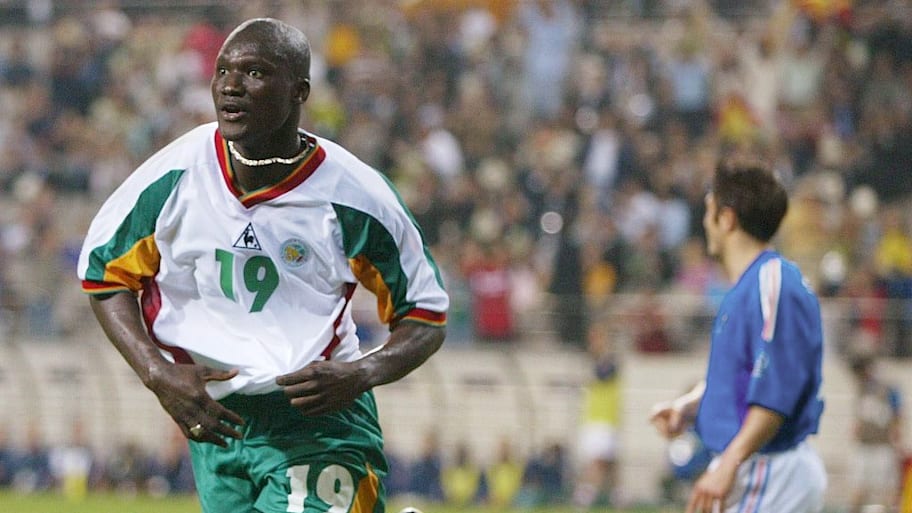
France were victorious on home soil in 1998, and arguably even more impressive when they triumphed at Euro 2000. They were destined for a deep run as the holders in Far East Asia, but the 2002 World Cup instead proved to be a nightmare for Les Bleus.
Senegal’s first-ever World Cup match arrived against the defending champions, and they relished the occasion, undoubtedly inspired by Cameroon’s run 12 years prior.
They’d long been regarded as underachievers, but green shoots were beginning to emerge under Bruno Metsu. Senegal were beaten AFCON finalists at the start of 2002, and there was a growing feeling that something special might be brewing as they prepared for the grandest stage.
However, even the most optimistic fan believed a victory over the superstar-laden France to be beyond them. Les Bleus, though, were without the injured Zinedine Zidane and later described by defender Lillian Thuram as “lacking humility” in their tournament opener.
Senegal pounced on not-exactly-unfamiliar French arrogance and, with a little bit of luck, stunned the holders thanks to Papa Bouba Diop’s scrappy finish 30 minutes in.
3. England 0–1 USA (1950)
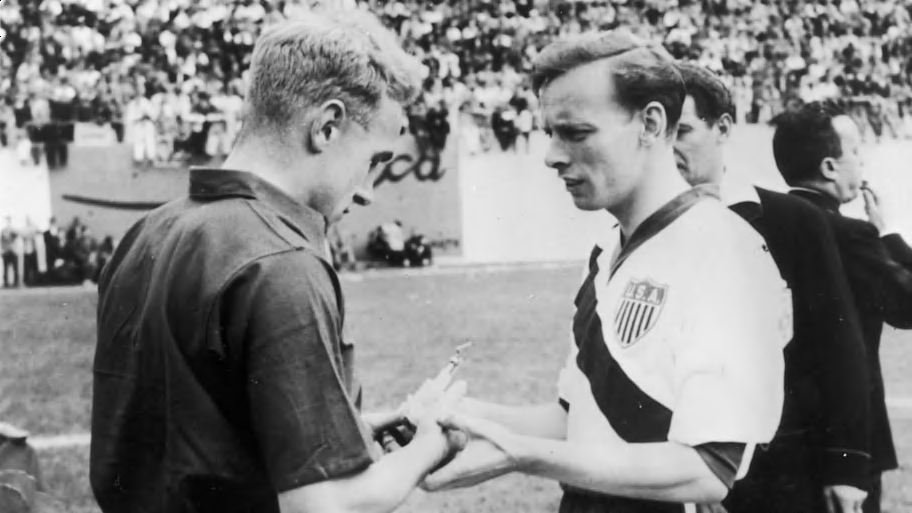
Having declined FIFA’s invitations for the first three World Cups, England opted in to the first tournament post-Second World War.
The English, who regarded themselves as pioneers and, ultimately, superior to the rest of the globe, carried a swagger with them to Brazil, expecting glory. A 2–0 win over Chile represented a rather serene start to the group stages, and an American team boasting a healthy supply of semi-pros was met with disdain.
However, England’s overconfidence contributed heavily to their stunning demise in Belo Horizonte. They missed countless opportunities early to put the game beyond the USA and were made to pay thanks to a glancing header from the Haitian-born Joe Gaetjens that thrust the part-timers into the lead before half-time.
Stiff resistance in the second half prevented the Three Lions from finding a way back into the game, and the USA held on for the unlikeliest of victories over the founding fathers, who subsequently bowed out of the competition after losing to Spain.
2. Brazil 1–2 Uruguay (1950)
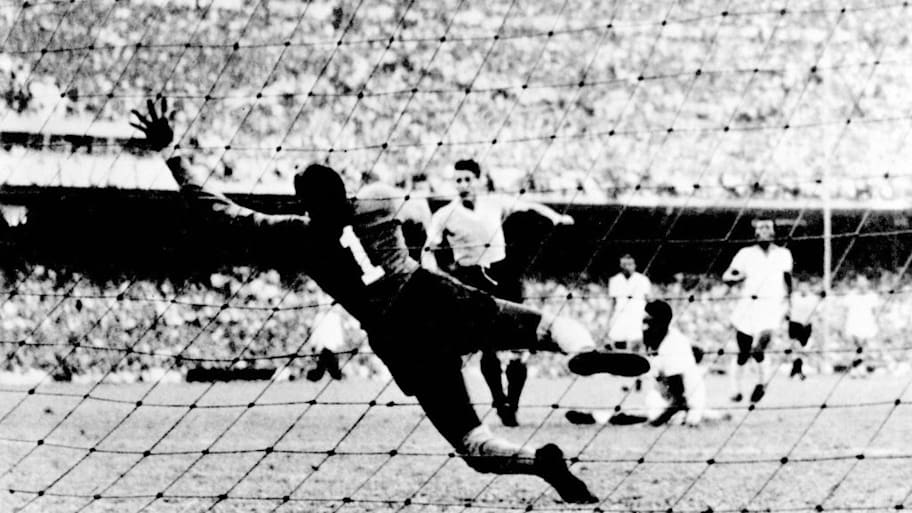
Officially, more than 173,000 crammed into the Maracanã, expectant of a Brazilian triumph, though many more may have been there to see the most influential match in the nation’s entire history.
The 1950 tournament boasted no one-off final, but instead a final group stage including four teams. Come the final matchday, Brazil needed just a draw against Uruguay to be crowned world champions, hence the local optimism.
The Seleção had been described by British journalist Brian Glanville as playing “the football of the future” at the tournament, with Uruguay regarded as gritty but far less talented and tactically inferior. However, the Uruguayans had seen the issues Brazil had up against Switzerland’s ’verrou’ system—a precursor to ’catenaccio’—and installed something similar for the all-important game.
The tactical shift worked, with Brazil thwarted for 45 minutes. However, the favoured hosts took the lead through a scuffed França shot just after the interval. Uruguay had been emboldened by their first-half showing, though, and knew they could live with the hosts.
Uruguay equalised midway through the second half to silence the Maracanã, and although Brazil merely needed a point, the underdogs seized the momentum and inflicted the killer blow that thrust a nation into mourning 13 minutes from time.
The Seleção wouldn’t take to the field again until April 1952.
1. Brazil 1–7 Germany (2014)
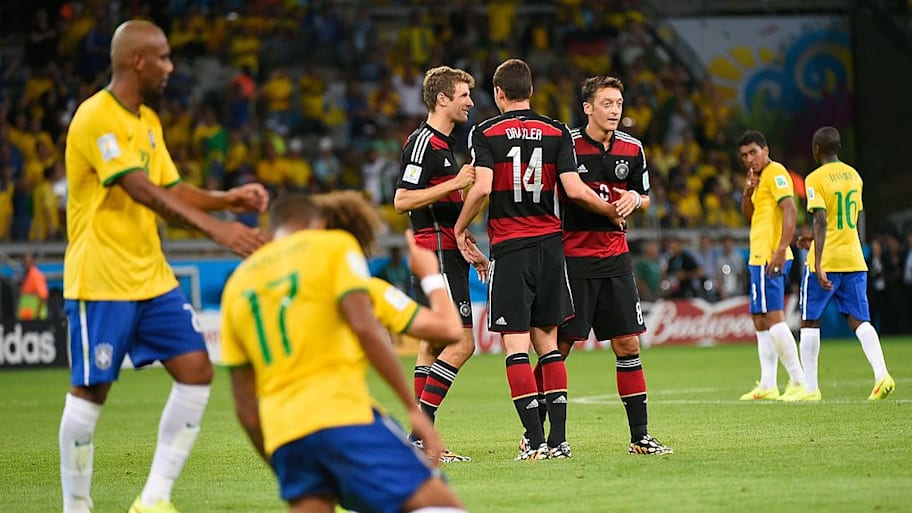
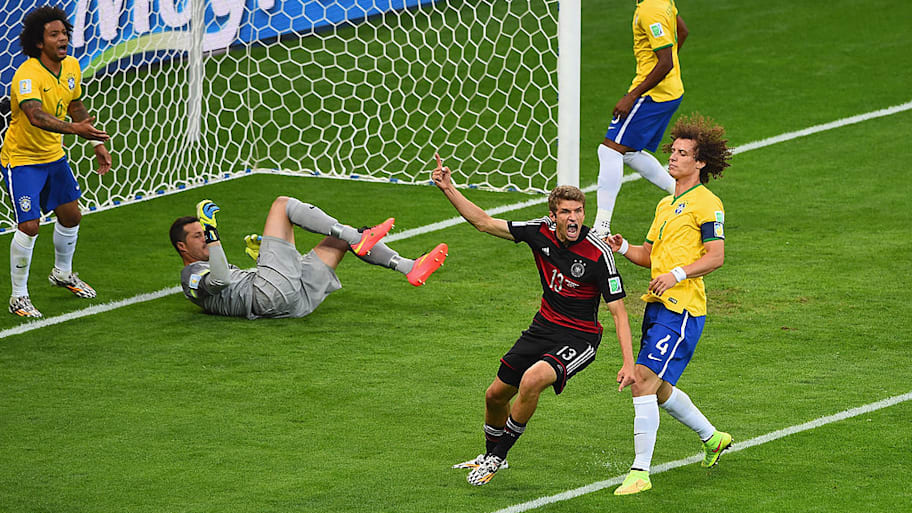
While the outcome of this semifinal in 2014 was no outlandish surprise, the scoreline was undoubtedly the most staggering in World Cup history.
Hosts Brazil rode a wave of unbridled emotion that summer. Of course, expectations were sky-high for the five-time winners, and despite the absence of a competent No. 9, the dreamers believed it to be Neymar’s destiny to guide the Seleção to the promised land.
The weight of expectation failed to inhibit the former Santos starlet, who became football’s first viral superstar and had moved to Barcelona the year before the tournament.
He scored twice in their win over Croatia to get the ball rolling, and Brazil qualified for the round of 16 as Group A winners. Chile were just about bypassed in the first knockout round, but the story of the tournament up to that point, Colombia, were swatted aside in the quarterfinal.
However, with Brazil cruising into the last four, a knee from Napoli’s Juan Camilo Zúñiga into the back of their leading man ruled Neymar out for the rest of the tournament.
Thus, for their semifinal against a ruthless Germany outfit that cared little for ’fate’ and ’destiny,’ Brazil were without their attacking heartbeat and stablest head in defence, with Thiago Silva suspended.
Still, not a soul foreshadowed the slaughter of Belo Horizonte. Brazil completely collapsed after falling behind, and were inexplicably 5–0 down within 29 minutes. To rub salt into the wounds, by scoring Germany’s second, Miroslav Klose usurped Ronaldo as the World Cup’s all-time leading goalscorer.
A hysterical Brazilian crowd eventually turned to cheering every German pass for solace. This was the Seleção’s bleakest night since 1950.
READ THE LATEST WORLD CUP NEWS, PREVIEWS & ANALYSIS HERE
This article was originally published on www.si.com as The 10 Biggest Shock Results in World Cup History—Ranked.