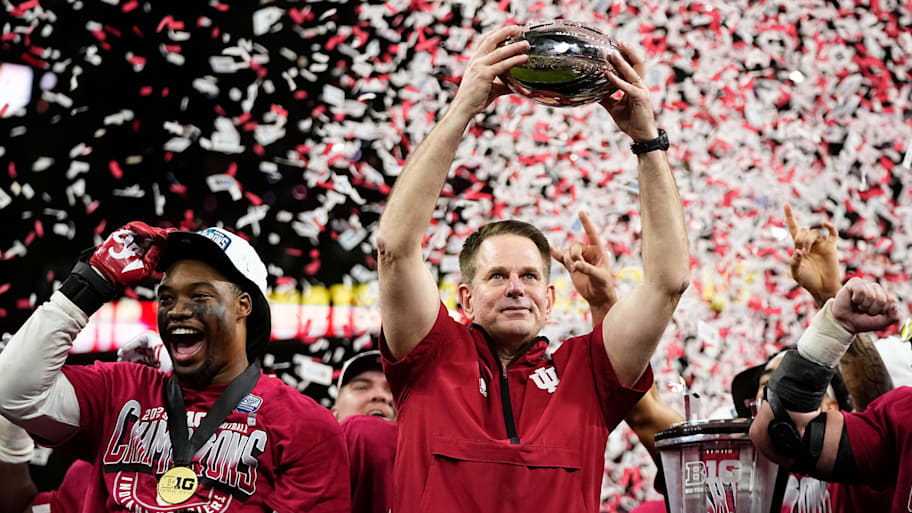
Scott Dolson only had a few days to act. It was the fall of 2023, Indiana had finished yet another dismal football season, this one 3–9. And it left Dolson, the school’s athletic director, seeking both answers and a new head coach.
He interviewed candidates by phone and Zoom. When it came time to speak with Curt Cignetti, then the head coach at James Madison, Dolson heard an earnest, prepared, no-bulls--- football lifer. But he also heard the echoes of a former Indiana coach.
When Dolson was an undergrad at Indiana in the 1980s, he was a manager for the Hoosiers basketball program. He was a junior in 1987 when Indiana last won an NCAA hoops title. And as he spoke with Cignetti that Thanksgiving weekend in 2023 … all the talk of a blueprint … and analyzing players … and stressing production over potential … and the power of watching film … it all carried an unmistakable ring.
“I don’t know why this popped in my head,” says Dolson, “but I thought about when Coach [Bob] Knight came here. Somebody asked him, Why did you go to Indiana? And he said, Because I knew I could win there.
“I said to Coach Cignetti at the very end of the call, I said, you know, ‘I really enjoyed our conversation. But, you know, I really wanna know, Do you think you could win here at Indiana?’ And he paused for a second. And he said, ‘Scott, lemme just tell you this: If I have average resources and a commitment to football, I will win there. There’s no question in my mind.’ ”
Thinking about the parallels, Dolson says, “It was unreal.”
Turned out, this would be a bit of foreshadowing.
Barely two years after Cignetti’s job interview, Indiana is, of course, the belle of the Power 4 ball, the Big Ten champ, the No.1 team in the country for the first time in school history and the No. 1 seed heading in the College Football Playoff. The program that entered the season with 715 losses, the most in college football history at the time? Indiana had not added to that loss total and is now in pursuit of its first national title.
The Hoosiers’ turnaround has been accompanied by a rehashing of Indiana coaching lore, such as it is. It’s almost like a family photo album. Out have come the images and stories of Lee Corso, the Hoosiers’ longtime coach-slash-gallows-humorist, who was fond of beginning his Sunday coaches show—inevitably after a loss—by emerging from a coffin and exclaiming, “We ain’t dead yet!” (Yes, even in the 1970s and ’80s, Corso was great TV.)
There have been stories about Bill Mallory, the winningest coach in the program history, who still had a losing record of 69-77-3—telling you plenty about the Hoosiers’ sustained football futility. There was fiery Sam Wyche, who left to go coach the Cincinnati Bengals. And Terry Hoeppner, who was respected and beloved, and also struck by brain cancer, dying tragically and now honored with an Indiana limestone rock that remains, literally, an Indiana football touchstone. And bullying Kevin Wilson, the less said here, probably the better.
But there’s another former Indiana coach who’s been referenced more than the others. And football wasn’t even his sport.
It’s been more than a quarter-century (I know, right?) since Bob Knight and Indiana parted ways in a bitter, prolonged divorce. And still, it’s a wound that hasn’t completely healed. There remain Knight loyalists on campus, including in some of the biggest offices of the athletic department. In other pockets, Knight persists as an ineradicable stain on the school, a vulgar tormentor who thought he was bigger than the university, whose excesses were tolerated for way too long.
Maybe if the basketball program, post-Knight, had reentered the business of winning championships, the fabric would have been repaired. Maybe if Knight had accepted the various olive branches extended by the school, the rupture would have closed. But those are counterfactuals.

Upstairs at Nick’s, America’s best campus bar, there is a wall devoted to Knight, adorned, fittingly, with images of him winning and also losing his mind. But on campus proper? There is a striking absence of Knight acknowledgement, even amid the athletic facilities. (Win three national championships and coach a U.S. Olympic team to gold and you can’t even get a weight room, a practice gym, a … something named in your honor?)
But now, the giddiness over the Hoosiers’ football success comes with this added bonus: It has united a cleaved base, sewn the tapestry back together. Finally, it’s provided what the therapy crowd would call processing and closure.
Cignetti and Knight never met. And Knight died at age 83 in November 2023 … just a few weeks before Cignetti’s fateful arrival in town. But for so many, Cignetti represents a kind of validation-by-proxy of Knight and his methods.
See, there’s still a place in college sports for the hard-ass coach, who demands accountability of his players. Among all the Pitinos and Petrinos one state down in Kentucky, and the unholy mess upstairs one state up in Michigan, there’s still room for authenticity and honored promises. There’s still space for the college coach who prepares meticulously. Who, by actions and words—his intensity and his phrasing—can motivate his players and tease out excellence. Who can win games by outcoaching his counterpart.
Just as Knight took ownership of his program and wasn’t one to delegate, it’s not been lost that Cignetti, a rare exception, has no general manager. He’s the leader and CEO, and he’ll run the show as he sees fit, thanks.
Dolson says he’ll walk into football practice and he’s transported to the Assembly Hall in the ’80s. Same for Don Fischer, Indiana’s venerable football and basketball broadcaster since 1973. As he put it to me this month: “I would consider both of ’em to be old-school coaches in the sense of what they expect out of their players—discipline, mental toughness, focus. Work your butt off when you’re on the practice floor, work your butt off when you play in a ball game. They are disciplinarians. They like certain things done the right way, and they don’t want any of the BS that you can see coming from players sometimes that you see on fields after—the excessive celebrations and the things that players do these days. Bob Knight didn’t want his players actin’ up and that kind of thing. And Cig doesn’t either. Coach Knight was a film junkie, too. And he could break down film like no basketball coach I’ve ever met around … Cig, too.”
Fischer says Indiana football practices remind him of Knight-era Indiana basketball practices. The sessions seldom last long, sometimes not even a full hour, but not one minute is wasted. There’s the sense that respect is not demanded, but earned. A team is not a democracy … Fischer stops himself to chuckle at it all. “When you look at what Coach Knight did and what Coach Cignetti’s done, there are so many similarities.”
At some level, it stands to reason. Knight and Cignetti. Cignetti and Knight. They grew up barely two hours apart, Knight in northeast Ohio, Cignetti in northwest Pennsylvania. They were both high school stars and solid college players—Knight at Ohio State, where he won a national championship in 1960; Cignetti at West Virginia where he backed up future NFL quarterbacks Oliver Luck and Jeff Hostetler. But both Knight and Cignetti were the kind of athletes who couldn’t rely on native talent, so, instead, they became students of the game. Both won at smaller programs (Knight: Army; Cignetti: Elon and James Madison) before winning at Indiana. Both took to the chess match of in-game coaching.
The compare-and-contrast goes only so far. Knight was a Boy Genius, who was in his early 30s when he came to Bloomington, Ind., and won three national titles when he was still in his 40s. Cignetti was 62 (!) when Dolson tapped him for the job and he finally got his big Power 4 break.

They coached in different eras, too, of course. Cignetti has benefitted greatly from (and had to manage) the complications of NIL, revenue sharing and the transfer portal. (A digression/thought exercise while we’re here: Knight and his unbending ways caused an army of players to transfer out of Bloomington, Larry Bird chief among them. If players didn’t have to sit out a year before playing at another school, would still more players have left Knight’s teams? Or would this bit of athlete empowerment have forced Knight to rethink and soften his ways?)
Above all, Cignetti does not suffer Knight’s lapses in decorum. “Google me” and “Purdue sucks” do not even rival Knight’s milder offerings in the outrageous quote department. The anti-Knight crowd can—and does—point to Cignetti as a repudiation of Knight. See, you can run a disciplined, winning program and do so without choking players and flinging chairs like frisbees and engaging in a blood feud with a school president.
This, too, is a form of closure.
Like Knight a generation ago, Cignetti has overseen this surplus of winning, invigorating Indiana, turning a leafy campus in flyover country into a relevant nerve center for their respective sport. Beyond that, Curt Cignetti has changed the very paradigm of the college football coach. Athletic directors are now looking for “the next Cignetti,” and instead of hiring the slick, young $2-million-a-year coordinator at a Power 4 U, they are looking for unmined coaching gems, the lifers who have actually run a program, hired coaches, managed games, built cultures and won. “Literally,” says Dolson, “he’s changing the future of the sport.”
He’s also helping Hoosier Nation reconcile the past and move forward.
Editor’s note: Some reporting for this was done in conjunction with this 60 Minutes segment on Indiana football, you can watch here.
More College Football from Sports Illustrated
Listen to SI’s college sports podcast, Others Receiving Votes, below or on Apple and Spotify. Watch the show on SI’s YouTube channel.
- Think Blowouts Make the College Football Playoff a Joke? It May Be Selective Memory
- Lane Kiffin Lands Huge Bonus From LSU Thanks to Ole Miss’ CFP Win
- Johnny Manziel Issues Statement After Missing 'College GameDay' Appearance
- College Football World Had a Lot to Say As Tulane, James Madison Got Demolished in CFP
- Pete Golding Explained What Kept Ole Miss Locked in for CFP After Lane Kiffin’s Exit
This article was originally published on www.si.com as Curt Cignetti Led Indiana to Impossible Success and Closure for Bob Knight.