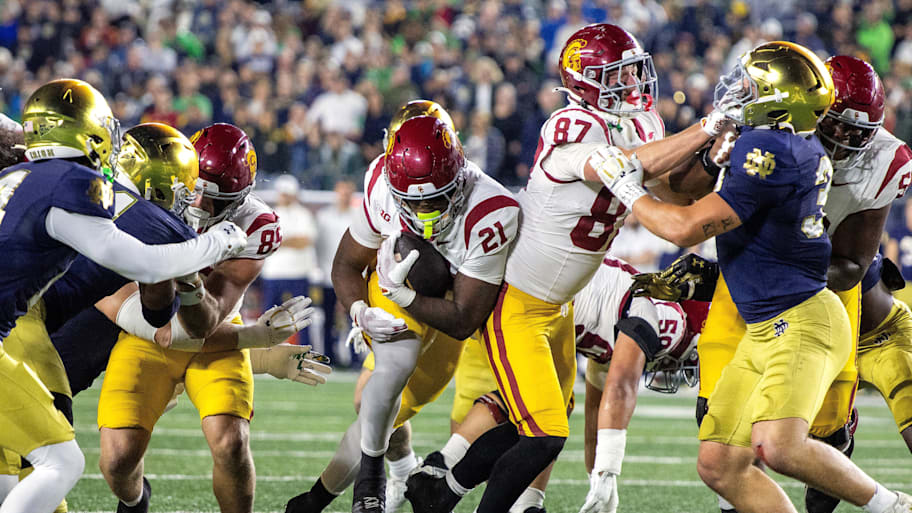
The greatest intersectional rivalry in college football history is coming to an end, and the College Football Playoff is a big part of the reason.
On Monday, Notre Dame announced it had filled its open date in 2026 with BYU, effectively ending any chance its rivalry with USC would continue next season. The two sides had been attempting to hash out a deal to keep the game going in the future, but couldn’t come to an agreement. In the end, Notre Dame’s future sweetheart deal with the College Football Playoff played a huge role in ending the series.
Except for three years during World War II and the 2020 pandemic season, the teams have alternated home games every season since 1926. Since 1961, they have played in South Bend in mid-October in odd years, and in Los Angeles in even years. USC wanted to change that schedule to accommodate its Big Ten schedule and the added travel that it brings. The Trojans proposed playing earlier in the year, when the rest of the conference’s teams have their non-conference games. Notre Dame steadfastly refused, preferring to keep the current arrangement.
According to Ryan Kartje of the Los Angeles Times, USC was ready to compromise and continue the rivalry as it was for the next two seasons before Notre Dame’s deal with the CFP came to light.
The memorandum of understanding, reached in March 2024, assures Notre Dame that if it finishes the season ranked in the top 12, it would be guaranteed a playoff berth. It will go into effect in 2026, and if it had been in place this season would have put the Irish into the CFP ahead of Miami. The agreement only covers next year’s CFP if it remains at 12 teams or expands to 14 teams and the at-large pool grows to nine programs; in a 14-team field, Notre Dame would receive an automatic bid if it ranks in the top 13, per Yahoo’s Ross Dellenger.
Kartje claims that once USC learned of that deal, it went back to demanding the two teams play in Week 0 in 2026:
“The two schools nearly announced a continuation of the series around the time of their October matchup in South Bend, Ind. A person familiar with the negotiations told The Times that USC was ready then to compromise and stick with the rivalry’s usual cadence over the next two seasons, with Notre Dame coming to the Coliseum in 2026.
“But at the time USC officials were not aware Notre Dame reached an agreement with CFP officials that guaranteed the Irish a playoff spot if they finish in the top 12 of the final rankings starting in 2026, the person said. To USC officials the agreement felt like ‘a material advantage’ to the Irish, whose place as an independent and scheduling flexibility already afforded them a considerable edge in positioning for the playoff over other programs, like USC, that are tethered to a conference.”
According to Kartje, USC officials were also wary of the CFP selection committee hitting teams hard for late-season losses. After Notre Dame’s agreement came to light, the Trojans said the game would have to be played in Week 0 in 2026 and ’27, or the rivalry would end for the time being.
USC made its final offer last week. Notre Dame athletic director Pete Bevacqua called his USC counterpart Jen Cohen on Monday to turn down the offer and end the rivalry. Bevacqua then publicly announced a multiyear agreement with BYU.
Notre Dame claims the rivalry can’t continue before 2030, while USC contends it could resume in 2028.
Cohen and USC intend to fill a home game in Week 0, with former Pac-12 rivals Stanford and Cal mentioned as possibilities.
More College Football on Sports Illustrated
- UCLA QB Nico Iamaleava Announces Decision for 2026 As JMU's Bob Chesney Takes Over Bruins
- Texas Tech Coach Has Pointed Advice for Notre Dame After CFP Snub
- Michigan Interim Coach Biff Poggi Offers Blunt View on ‘Malfunctioning’ Program
- Ryan Day Details Who Will Call Ohio State Offense in CFP After OC’s Departure
This article was originally published on www.si.com as Notre Dame’s Future CFP Agreement Played Big Role in USC Rivalry Falling Apart.