COLUMBUS, Ohio (WCMH) — A warm, muggy Memorial Day in Ohio five years ago featured hazy sunshine and temperatures well into the 80s.
However, parts of Ohio were on alert for the risk of severe storms arriving a few hours after sunset.
Low pressure tracking across the Midwest and a warm front would pull the ingredients together for dangerous thunderstorms that began forming in central Indiana toward sunset. Usually, storms gradually weaken with nighttime cooling, but that did not happen on the night of May 27, 2019.
The first tornado to hit Ohio struck Mercer County and Celina just past 10 p.m. The EF3 tornado packed 150 mph winds, and killed an 82-year-old man when an unoccupied car was tossed into his home. Eight others were injured by the by the storm that was on the ground for 11 miles.
Rotating thunderstorms developed rapidly farthger south in the energized environment, spinning off a violent EF4 tornado west of Brookville in Montgomery County at 10:41 p.m. that plowed east for 20 miles through Trotwood, Dayton and Riverside.
Neighborhoods were wrecked through the northern portion of Dayton. Tragic scenes unfolded in the darkness, where homes were torn apart by winds estimated at 170 mph winds. The tornado stripped away the roofs of homes and businesses and scattered the pieces for miles. Downed trees and power poles knocked out the power grid and snowplows were used to remove debris along Interstate 75 around Dayton.
Aerial photography and ground surveys conducted by the National Weather Service office in Wilmington helped determine the storm’s extreme path and intensity. Remarkably, no deaths were reported in the Dayton area due to prompt Weather Service and media warnings that sent residents for cover in basements, and interior rooms or closets on the lowest floor. A total of 166 people were injured.
A strong EF3 tornado, with 140 mph winds, touched down near West Milton in Darke County at 10:25 p.m. and traveled 11 miles into Miami County.
Another EF3 tornado touched down in Riverside shortly after 11 p.m. that tracked into western Greene County, damaging a hangar and another building near the National Museum of the U.S Air Force, which ic part of Wright-Patterson Air Force Base.
The tornado continued east to Beavercreek, bringing down trees and damaging homes. At its peak, winds reached 140 mph (EF3) along a 10-mile path that was three-quarters-of-a-mile wide. The weakening tornado lifted north of Xenia, after damaging or destroying more than 100 homes.
After midnight, rotating storms spun off three more tornadoes south of Columbus, at Circleville and farther down State Route 56 at Laurelville in Hocking County.
The final touchdown occurred at 2:30 a.m. at Roseville, Perry County. A total of 21 tornadoes were confirmed by National Weather Service offices. The only more active day in Ohio weather records was July 12, 1992, when 28 tornadoes were confirmed, though none of these storms approached the intensity of Memorial Day in 2019.
The nighttime aspect of this historic outbreak — between 10 p.m. on May 27 and 2:30 a.m. on May 28 — made the situation all the more frightening, because tornado spotting at night is nearly impossible, unless revealed by lightning flashes.
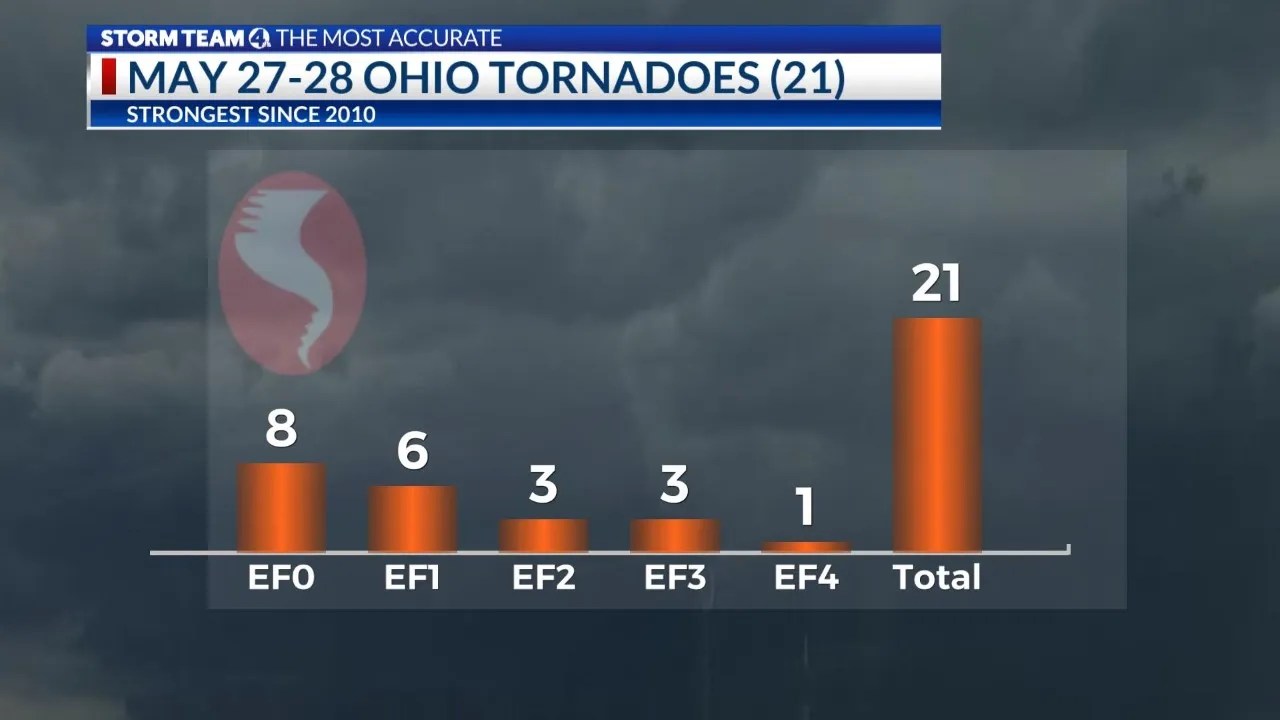
The EF4 tornado that moved through the Dayton area as the strongest tornado in Ohio since June 5, 2010, in the Millbury area, Wood County.
Advancements in Doppler radar technology detect early signs of rotation, or signatures, indicating winds moving in different directions and possible lofted debris. Timely warnings undoubtedly prevented a significant loss of life and more injuries on the night of May 27-28, 2019.